Why is American Steel (and other metals) important? This subject has come up from weird angles this year, mostly from the standpoint of tariffs and politics. While it’s true that American jobs (which equate to actual real people and families) are at stake, this subject goes incredibly deeper. I’d like to take you a little further into this situation, in hopes you’ll understand how much is at stake every day.
In the late 1800’s, the American railway system was being built. Steel mills were coming of age and were crucial to these railways. Steel was truly hot, and quality control was truly nowhere to be seen. One length of rail could be made of completely different metals, and have different shapes and dimensions from other rails. Slag and other contaminants could render a mile of rail completely useless. It was expensive to haul these rails across the country, only to have a train derail and wreck and entire section of rail line. Something had to change.
Enter the American Society for Testing and Materials (ASTM)! They were created to develop standards for the manufacturing of basic materials, like steel, aluminum, bolts, plastics, etc. These standards were (and still are) used to verify that various materials meet real standards of quality, composition, measurements, shapes, etc. American steel mills signed onto this regimen, and have continued to do so ever since.
As time went on and electric arc welding became a more mature process, an entire organization called American Welding Society (AWS) was born. AWS develops welding materials and processes that work perfectly with materials specified by ASTM. This relationship is very crucial, because welding materials need to have a metallurgical composition that is similar to the base metals. If the metallurgy isn’t right, then the metals can’t be successfully welded.
I’ve welded my whole life, and my dad always told me how important metallurgy is. I dabbled to know a little here and there, but it hit me in the face (literally) several years ago: We worked on a building that was being constructed of beams made in Lithuania. The engineers wanted angle welded to those beams so building steel could be hung from them. Seems like an easy project, right?
Well, not exactly. Those Lithuanian beams were metallurgically inferior and incompatible with American (AWS specified) welding rod. The case was so bad that we could weld just fine for 4 or 5 inches, then hit a pocket of impurities, and the whole thing would blow up in our faces leaving a big crater that then had to be filled in order to continue welding.
What happened here? After we took a sample piece of the beam steel to a testing facility, we were informed that the steel “mostly” met ASTM standards, but had pockets of impurities so severe that all of the beams had to be tested, and quite a few of them replaced. Also, the Lithuanian steel did not meet ASTM standards exactly, which meant it was not metallurgically compatible with American (AWS Specified) welding materials. As a result, quite a few of the beams had to be reinforced in order to leave them in service. The cost of performing the project was suddenly 100 times higher than projections, just because the steel was questionable.
Yes, Canadian steel does mostly align with American standards. Canadian materials are specified by the Canadian Standards Association (CSA), with welding materials specified by the Canadian Welding Board (CWB). You’ll hear that Canadian materials and welding standards are more stringent than American standards, which is possibly true in some ways. However, materials made under those standards aren’t guaranteed to be compatible with American materials. There’s a huge risk of disconnect, and it does occasionally happen, especially under conditions where there is less control of processes and quality.
An example where this has occurred recently with aluminum is a recent all terrain manlift I worked on. It was made in Germany with German Materials. I spent hours trying to get AWS specified welding rod to form a puddle and fuse with the aluminum mast material. I finally got a little “something” to happen, but it sure wasn’t a weld to call reliable. Aluminum is a very finicky material when it comes to welding. If the alloys and conditions aren’t right, a weld will be virtually impossible. Coming full circle, ASTM specified aluminum would have been more likely to be compatible with AWS specified welding rod than the German “equivalent.”
While we worry about tariffs and politics, it’s important to remember the functional side of this argument. Incompatible or inferior materials can be exponentially more expensive than any tariff.
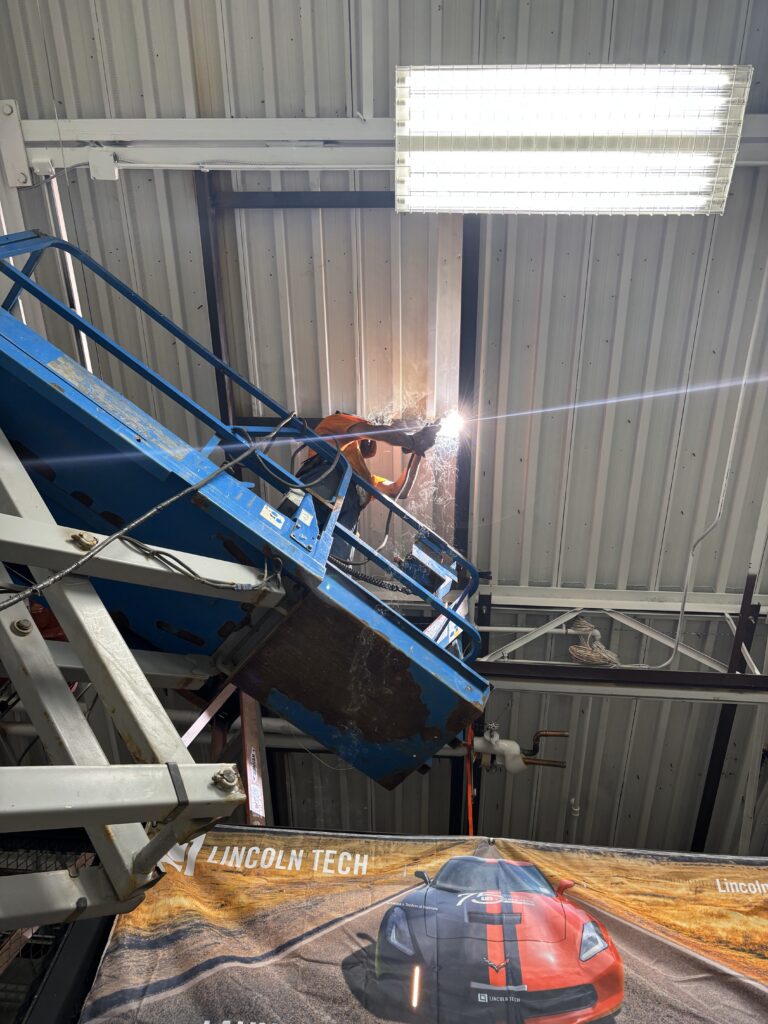
For our parting shot, check out Dynamic Custom Services reinforcing roof joists using ASTM specified steel and AWS welding rod: